

IT Operations X-ray
Something is wrong, but the cause is unclear.
The same incidents, delays, or compliance problems keep returning. I map how the work actually runs and identify the few constraints creating most of the noise.
Plain Ops Consulting
I find out what is actually happening, identify what is blocking the result, show which decisions are needed, and finish the agreed work.
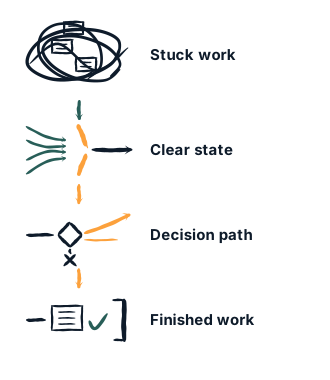
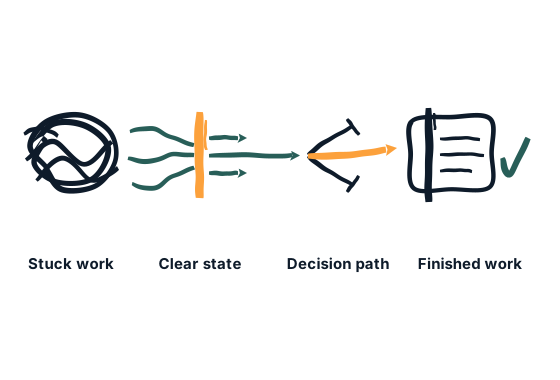
How I work
Your team usually knows where the problems are. I make those problems clear without turning the work into a performance review.
I focus on patterns, handoffs, decisions, and evidence. Findings are not attributed to individuals.
Services
You do not need to diagnose the problem before calling. Start with what is not working and the result you need.
IT Operations X-ray
The same incidents, delays, or compliance problems keep returning. I map how the work actually runs and identify the few constraints creating most of the noise.

Agree on the result, what counts as done, who can make which calls, and how the work hands back. Then finish it.

Execution Leadership
Temporary leadership for an agreed period, with clear owners, decisions, order of work, and review schedule.

Fractional IT Operations Leadership
I provide focused IT operations leadership through a transition, stabilization period, or leadership gap, then hand it back cleanly.
How I work
Map how it actually runs across teams and vendors.
Separate the visible problem from what repeatedly creates it or prevents completion.
Measure the effect where the evidence permits it.
Leave the sequence, working material, or leadership needed to continue.
How work changes
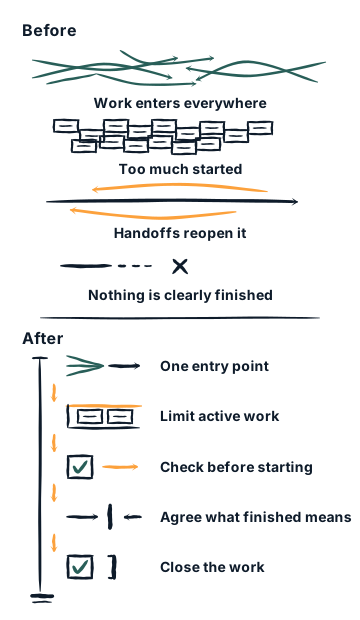
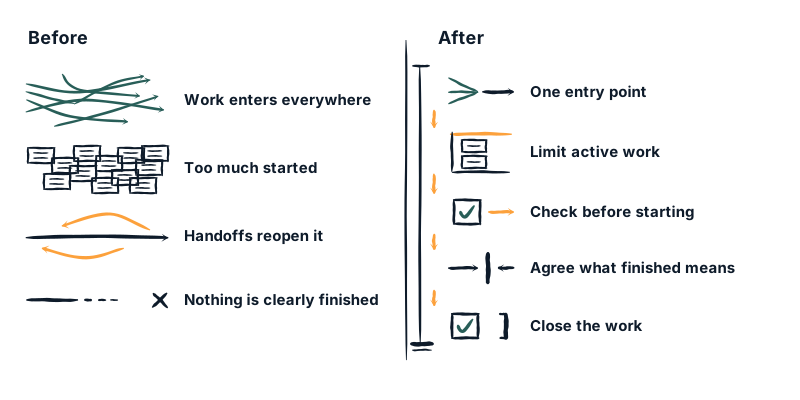
Important work slows down when it can enter anywhere, stay active without a decision, and reopen at every handoff.
The operating rule is simple enough to see: one entry, limited active work, a check before starting, and a shared finish.
Examples
The visible problem changes. The job does not: make the real state clear, find what keeps causing it, and change what makes it repeat.
View all examplesOperating example
What was happening: Production ran on aging systems with abandoned maintenance and no reliable operating baseline.
What kept causing it: Separate technical issues had no shared owner, schedule, or cost model.
What changed: The work began with evidence, ownership, and a usable modernization sequence.
Read the exampleOperating example
What was happening: Signed annual-value contracts waited roughly a year before kickoff and another four to eight months to reach go-live and invoicing.
What kept causing it: Sales kept closing while delivery throughput stayed comparatively flat, and scope and handoff rules let the queue keep growing.
What changed: Lifecycle and capacity rules reduced stale signed-contract backlog from roughly $22M to roughly $8M while ARR grew from $3.4M to $13.8M in 2020.
Read the exampleOperating example
What was happening: Spend lived across hundreds of lines that did not explain the operating choices behind it.
What kept causing it: Assets, depreciation, licensing, support, and lifecycle decisions lived in separate sources.
What changed: A consolidated cost model made capacity and capital choices visible.
Read the example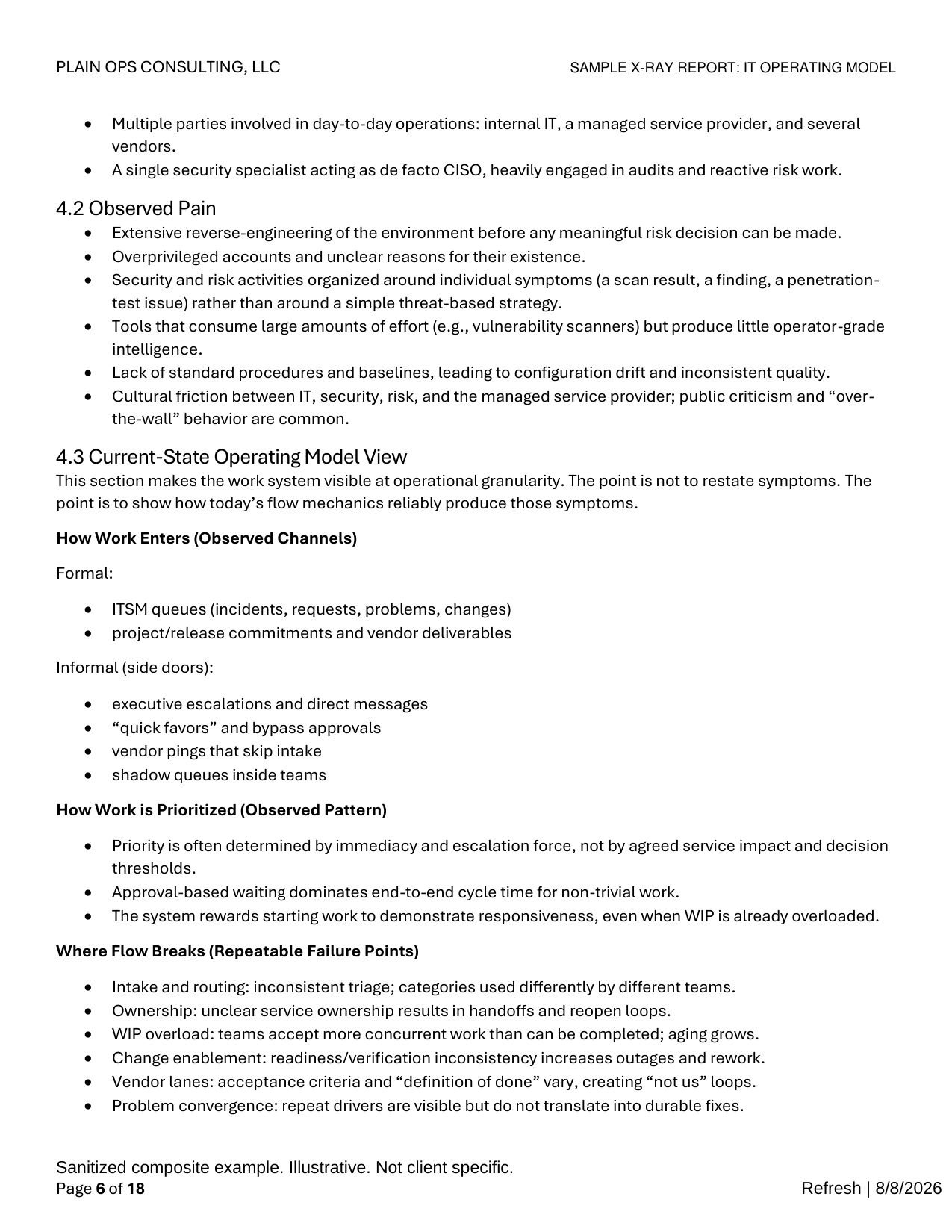
Finding: evidence and impact
Recommendation: action and success indicator
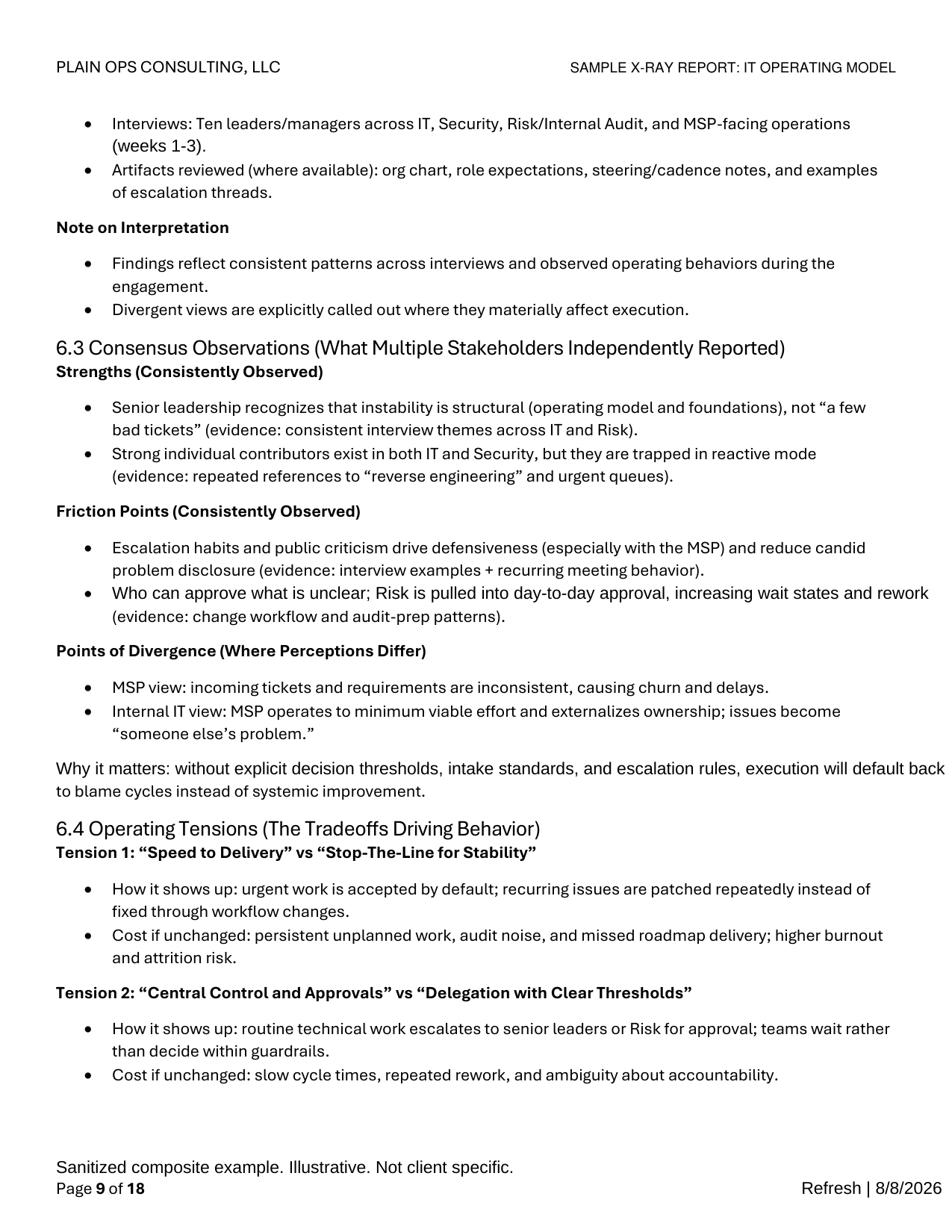
Sample report
The sample shows how findings, evidence, causes, decisions, and next steps connect without grading the team.
Plain Ops is for the point where the obvious fixes have already been tried and the result still has not changed. A leader changed. A tool was bought. More people were added. Another governance layer went in. I trace the work itself to find the operating constraint those fixes left in place.
BCG's 2021 research found that only 35% of companies achieved their digital transformation objectives. The point is not that every operating problem needs a transformation program. It is that making a result hold is harder than announcing a fix.
I do not assume better performance requires more spending. In prior roles, a 65-person IT organization finished at 42 while major incidents fell 60% and broad incident MTTR fell 79%. I also rebuilt an $8.5M one-year infrastructure proposal into a three-year plan with about $3M lower projected spend, and negotiated a $2.35M infrastructure package to about $1.1M.
That is the standard I bring to Plain Ops: understand what is actually constraining the result before adding cost, tools, or another layer of management.
The Plain Ops overview explains the work in a short PDF you can send without writing the introduction yourself.
Tell me what is not working and what result you need. No pitch deck or diagnosis is required.